English
Insulated Copper Tube

Author: Site Editor Publish Time: 2026-11-09 Origin: Site


Mini split line set sizes usually identify the outside diameters of two copper refrigerant tubes. A listing such as 1/4″ × 3/8″ commonly means a 1/4-inch liquid line paired with a 3/8-inch gas line. Read the column headings or product description to confirm the order, because equipment manuals may list the gas side first.
To select a line set, use the piping requirements for the exact indoor and outdoor unit combination. Then specify the copper wall thickness, insulation, length, and end configuration. These details determine whether a listed size pair is suitable for the installation.
Table of Contents
In a size combination such as 1/4″ + 1/2″, the two fractions describe separate tubes. The plus sign or multiplication sign groups the pair. It does not describe the wall thickness, insulation thickness, or finished width of the assembly.
For air-conditioning refrigerant tubing, confirm that the listed dimensions refer to copper outside diameter, often abbreviated as OD. Keep that measurement separate from nominal plumbing pipe sizes and the overall dimensions after insulation is applied.
The smaller tube is commonly identified as the liquid line and the larger tube as the gas line. A supplier listing may use “suction line” for the larger tube. For a reversible heat pump, use the equipment manual’s terminology and connection labels when checking the order.
Write both line names in the purchase specification. This avoids ambiguity when one document lists liquid first and another lists gas first. For example, specify “liquid OD 1/4 inch, gas OD 1/2 inch” alongside the paired size.
One inch equals 25.4 mm. The table below gives exact mathematical conversions of the fractional inch dimensions. Equipment manuals may use rounded metric labels, such as 6.4 mm for 1/4 inch or 15.9 mm for 5/8 inch.
Copper tube OD in inches | Exact conversion in millimeters | Rounded metric label often encountered |
|---|---|---|
1/4″ | 6.350 mm | 6.35 or 6.4 mm |
3/8″ | 9.525 mm | 9.52 or 9.5 mm |
1/2″ | 12.700 mm | 12.7 mm |
5/8″ | 15.875 mm | 15.88 or 15.9 mm |
3/4″ | 19.050 mm | 19.05 or 19.1 mm |
7/8″ | 22.225 mm | 22.22 or 22.2 mm |
Use the original tube designation and required tolerance when ordering. A nearby metric dimension should be checked against the specified tube and connection requirements before substitution.
Combinations such as 1/4″ + 3/8″, 1/4″ + 1/2″, and 1/4″ + 5/8″ are useful ways to organize line-set inventory. Each identifies a pair of tube diameters. The equipment documentation establishes which pair applies to a particular model combination.
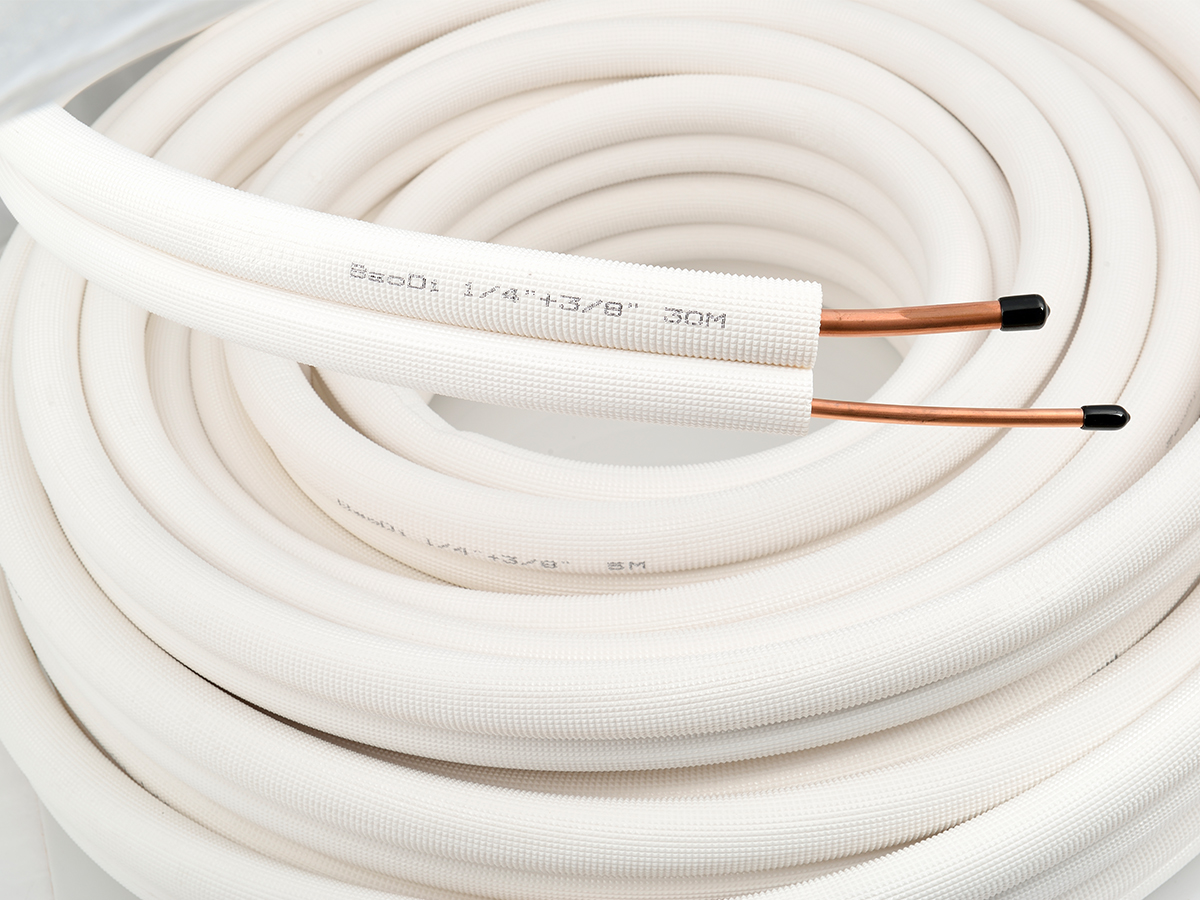
XLBAODI’s twin PE insulated copper pipe page lists the following supply combinations. The sleeve bore values are insulation dimensions and should be read separately from the copper OD.
Listed copper OD pair | Listed copper wall thickness pair | Listed insulation bore pair |
|---|---|---|
1/4″ + 3/8″ | 0.8 + 0.8 mm | 8 + 12 mm |
1/4″ + 1/2″ | 0.8 + 0.8 mm | 8 + 15 mm |
1/4″ + 5/8″ | 0.8 + 1.0 mm | 8 + 19 mm |
3/8″ + 5/8″ | 0.8 + 1.0 mm | 12 + 19 mm |
3/8″ + 3/4″ | 0.8 + 1.0 mm | 12 + 22 mm |
1/2″ + 3/4″ | 0.8 + 1.0 mm | 15 + 22 mm |
Confirm the proposed combination against the selected equipment and order specification. This table describes listed product options rather than assigning them to particular mini split capacities.
A complete listing may include tube diameters, insulation thickness, coil length, and end preparation. Parse each field separately. A reference to “1/2-inch insulation” describes the insulation wall, while “1/2-inch gas line OD” describes a copper tube.
For a paired assembly, confirm the insulation requirement for each leg. Also check whether the quoted length applies to both tubes and how any exposed connection ends are measured.

Capacity is useful for identifying equipment, but a BTU rating alone leaves important piping requirements unresolved. Retain the full indoor and outdoor model numbers on the piping schedule.
For multi-zone installations, identify the branch or connection the line set serves. Different sections of the system may have different requirements. Use the applicable diagram and table when preparing the purchase order.
An insulation sleeve has an inside diameter, or bore, selected to fit around the copper. For example, 1/4-inch copper has an exact OD of 6.35 mm, while a supplier may list an 8 mm sleeve bore for the proposed construction. Those values describe different parts of the assembly.
Ask the supplier to confirm the intended fit and tolerances. If purchasing insulation sleeves separately, provide the actual tube OD and the required insulation specification.
Copper wall thickness is separate from copper OD. It affects the tube’s internal dimensions and is part of the required tubing specification. Two tubes with the same OD can therefore have different wall thicknesses.
Check the equipment and project requirements for tubing material, condition, dimensions, and applicable standard. When purchasing single insulated copper pipe, state both OD and wall thickness for each line.

The insulated assembly is larger than the bare copper. Request the finished diameter of each leg and the overall width and height of a twin assembly where clearance is restricted.
Check openings, trunking, and the room available at bends. Include the final approach to the equipment, where the paired legs may need to separate and align with ports at different positions.
Locate the piping section of the applicable installation manual. Record the liquid and gas tube dimensions, wall requirements, insulation, permitted line length, elevation limits, and connection details.
Measure the route using its actual bends and offsets. Review any requirements linked to length, including refrigerant charging instructions, with the installer. A longer route needs to remain within the manufacturer’s permitted design.
Check the required pipe-end condition, fittings, and nuts. An adapter may address a connection detail where the equipment manufacturer permits it. The field piping still needs to meet the specified diameter and wall requirements.
Ask the supplier to itemize the supply scope. Confirm whether the quotation includes plain or prepared ends, protective caps, fittings, and accessories. Record the approved configuration on the purchase order.
RFQ field | Information to include |
|---|---|
Equipment | Indoor and outdoor model numbers, or an approved piping schedule |
Liquid line | Copper OD and wall thickness |
Gas line | Copper OD and wall thickness |
Insulation | Material, thickness for each leg, and exposure requirements |
Length | Required length of each tube and end-coverage details |
Supply format | Twin assembly or two single insulated tubes |
Connections | End preparation, fittings, and nuts where required |
Order details | Quantity by size and length, markings, packaging, and destination |
For repeat installations, check a sample against the equipment connections and a representative route. Confirm markings, dimensions, insulated coverage, and end condition before approving bulk supply.
It usually identifies two copper tube outside diameters. The 1/4-inch tube is commonly the liquid line and the 3/8-inch tube the gas line. Confirm the labels and compatibility in the equipment documentation.
Use the exact indoor and outdoor model combination to confirm the piping. Models with similar capacities can have different requirements, so retain the manufacturer’s piping specification with the order.
Pipe diameter is part of the system design. Use the specified size or a manufacturer-approved alternative. Review any proposed change with the applicable technical documentation before ordering.
Copper size describes the tube OD. Insulation bore describes the opening that fits around it. Confirm the supplier’s intended fit and tolerance, especially when purchasing sleeves separately.
Have the installer check dimensions, wall specification, condition, cleanliness, connections, and insulation against the replacement equipment’s requirements. Confirm any manufacturer restrictions on reuse before proceeding.
Preparing a mini split line-set order? Send XLBAODI your piping schedule, including both copper sizes and wall thicknesses, insulation requirements, lengths, quantities, and end configuration.


