English
Insulated Copper Tube

Author: Site Editor Publish Time: 2025-11-14 Origin: Site


Say goodbye to worrying about water drops on your pipes. When warm, wet air touches something cold, water drops can show up fast. This water can cause damage, mold, and bigger energy bills. You can trust insulated copper pipe to stop water drops before they start. > Insulation works like a shield. It keeps water away and protects your home. You feel calm and your home is safer.
Insulated copper pipes stop condensation. They keep warm air away from cold pipes. This helps protect your home from water damage and mold.
Picking the right insulation material and thickness is very important. Foam, rubber, and fiberglass all have special benefits. Each one works best in different places.
It is important to take care of insulated pipes. Check for leaks often. Make sure the insulation is not broken. This helps your plumbing last longer.
Insulated copper pipes can help you save energy. They keep the temperature steady. This means your HVAC system does not have to work as hard.
Installing pipes the right way is very important. Make sure all pipes are covered. Seal the joints tightly. Use the best insulation for your climate.
You might see water drops on copper pipes in places like basements, kitchens, bathrooms, and laundry rooms. This happens when warm, wet air touches the cold pipe. The air cools down fast. Water vapor turns into drops. This is called condensation.
Warm, wet air touches cold pipes.
Water drops appear on the pipe.
This happens more in rooms with lots of moisture.
How fast condensation happens depends on a few things. The table below shows what changes the speed of condensation:
Factor | Effect on Condensation Rate |
|---|---|
Relative Humidity (RH) | More humidity means more condensation |
Temperature Difference (DT) | Bigger temperature changes make more condensation |
Surface Type | Hydrophilic surfaces get more condensation |
If you live where it is humid or keep your home cool, you might see more water drops. The bigger the difference between air and pipe temperature, the more water you will notice.
Condensation on copper pipes can do more than make things wet. Over time, water drops can fall on floors or walls. This can cause many problems:
Higher water bills
Lower water pressure
Damage you can see on walls or ceilings
Mold can grow
You might hear dripping sounds
Pipes can change color
Mold is a big problem. It grows fast in wet places and can spread in your house. Getting rid of mold can cost a lot. For example, cleaning mold from HVAC systems and air ducts can cost $2,000 to $6,000. If mold spreads everywhere, it can cost $25,000 or more.
Insulated copper pipe helps stop these problems. The insulation keeps the pipe warm enough so water does not form. You keep your home safe from water damage, mold, and expensive repairs.
Insulated copper pipe makes a barrier. This barrier keeps warm, wet air away from the cold pipe. Water vapor cannot turn into drops on the pipe. The insulation wraps around the copper pipe tightly. It keeps the pipe’s temperature steady. It also blocks outside air from touching the pipe.
You can pick from different insulation materials. Each one helps stop condensation in its own way. The table below lists some common types and their benefits:
Insulation Material | Benefits |
|---|---|
Aerogel | Ensures internal temperature consistency and prevents condensation by blocking warm, humid air. |
Closed Cell Insulation | Effective for temperatures below freezing, preventing moisture from affecting the pipe. |
Reusable Insulation Jackets | Designed to fit snugly, allowing for easy removal and inspection while preventing condensation. |
Many people use closed-cell insulation because it blocks moisture well. Aerogel is good if you want the best temperature control. Reusable jackets are easy to take off and check. They help keep pipes dry.
You can also find insulation made from PUR foam and PIR foam. Both types slow down heat transfer. This keeps the pipe warm and dry. PIR foam is good for high heat and does not burn easily. Both foams have a closed-cell structure. This stops water from getting inside the insulation.
Tip: Always check if the insulation is thick enough and fits well. A tight fit gives the best protection from condensation.
Insulation stops heat and moisture from moving. When you wrap a copper pipe, you keep its surface above the dew point. The dew point is when air turns into water drops. If the pipe stays warmer than this, no condensation forms.
Moisture-resistant insulation is important in humid places. These materials use closed cells or vapor barriers to keep water out. For example:
Closed-cell spray foam seals air and blocks water. It has a high R-value.
Fiberglass insulation resists water if you use vapor barriers. You need to check it often.
Rigid foam boards last long and work in many places. Tape the seams for best results.
Mineral wool insulation stands up to humidity. Mold cannot grow on it.
You must also think about safety and building codes. The International Energy Conservation Code (IECC) has rules for pipe insulation. The table below shows some main rules:
Section | Description |
|---|---|
120.3(a) | Nonresidential, high-rise residential, and hotel/motel buildings must comply with insulation requirements. |
120.3(b) | Pipe insulation exposed to weather must have protective covers that are water retardant and shield against solar radiation. |
120.3(c) | Adhesive tape is not an acceptable method for providing protection to insulation. |
Most states use the IECC. Its rules for insulation thickness match ANSI/ASHRAE/IES Standard 90.1. Always check your local codes before you start.
Flame retardant insulation adds more safety. Fire-rated insulation helps stop fire from spreading. It keeps the building strong during a fire. It gives people more time to leave safely. Copper pipes do not burn and melt at high heat. They stay strong in a fire. If you use copper with flame retardant insulation, you lower fire risks.
Here are some fire safety standards for insulation:
Standard | Description |
|---|---|
EN13501-1 | European fire classification for construction products, ensuring materials meet fire safety requirements. |
DIN4102-1, B1 | German standard for fire behavior of building materials, indicating non-combustibility. |
UL-94 HF-1 | Underwriters Laboratories standard for flammability of plastic materials, ensuring low flammability. |
If you pick insulated copper pipe with the right materials, you protect your home. You stop condensation, mold, and fire. You also follow safety codes. Your pipes will work well for many years.
Insulated copper pipe helps keep your home safe from water damage. Moisture cannot touch the pipe, so no condensation forms. This means water does not drip on floors or walls. Mold needs water to grow, but insulation blocks it. High moisture resistance in insulation keeps mold away. You do not have to worry about costly repairs or health problems.
Insulation with strong moisture resistance stops condensation and mold.
Rubber insulation fights mold, condensation, and fire. It works well in humid areas.
Insulating pipes stops freezing, sweating, and condensation. These problems can cause mold.
Your home stays dry and safe. Your family is protected from allergies and breathing issues caused by mold.
Insulated copper pipe helps you save energy every day. The insulation keeps hot water hot and cold water cold. Your HVAC system does not have to work as hard. You use less energy and pay lower bills.
You can save about $3.74 per foot each year with insulated copper pipe in your HVAC system.
Insulation cuts down on heat loss and heat gain. Your system works better.
Using less energy means your heating and cooling equipment lasts longer.
You see savings grow over time. Your home feels comfortable all year.
Benefit | Description |
|---|---|
Energy Savings | Insulated copper pipes use less energy, lowering utility bills. |
Reduced Cooling Costs | Insulation keeps temperatures steady, so cooling systems work less. |
Increased Durability | Insulated pipes need fewer repairs, saving you money in the long run. |
Tip: Insulation helps your HVAC, refrigeration, and water systems work better. You spend less on energy and repairs.
You want your pipes to last a long time. Insulated copper pipe gives you that. The insulation protects pipes from heat, cold, and moisture. This stops corrosion and damage. Pipes do not crack or leak as much.
Insulation keeps pipes safe from freezing and thawing. In cold places, water in pipes can freeze and break them. Insulation stops this from happening. You avoid expensive repairs and water damage.
UV-resistant and tear-resistant insulation makes pipes even stronger. Some products, like EZ-Roll Plus™, have a black coating that does not tear easily. Regular insulation can rip and stop working well. UV-resistant insulation stays strong for years, even in sunlight. You do not have to fix or replace it often.
Feature | General Insulation | UV Resistant Product |
|---|---|---|
UV Degradation | Wears out after 3 years | Stays intact after 5 years |
Performance Impact | Can lower system quality | Keeps copper tubes working |
Installation Integrity | Needs repairs | No repairs needed |
Copper pipes also fight corrosion and bacteria. You get a system that lasts a long time and stays clean. Copper is recyclable, so it is good for the environment.
Insulated copper pipe works in HVAC, refrigeration, and hot/cold water systems. You get strong, reliable pipes that last for decades.
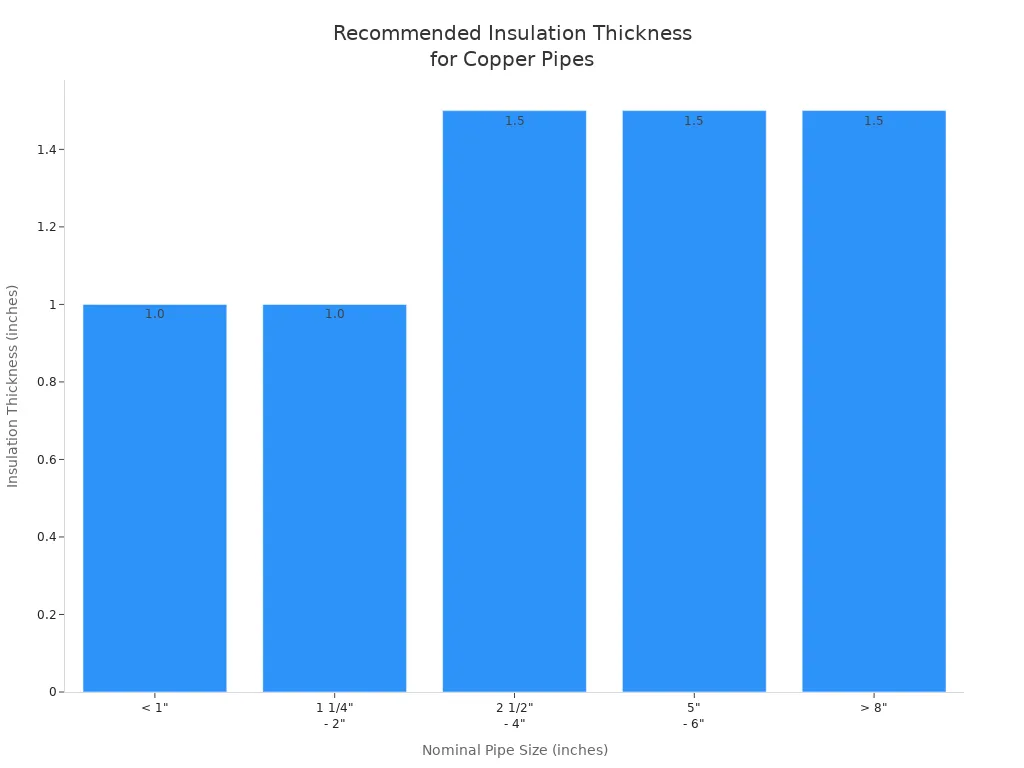
You have to pick the right insulation for your copper pipes. The thickness depends on pipe size and fluid temperature. Thicker insulation keeps heat in or out better. It also helps stop condensation in wet places. The table below shows how thick insulation should be for different pipe sizes and temperatures:
Nominal Pipe Size NPS (inches) | Insulation Thickness (inches) | Temperature Range (°C) | Temperature Range (°F) |
|---|---|---|---|
< 1" | 1.0 | 50 - 90 | 120 - 200 |
1 1/4" - 2" | 1.0 | 90 - 120 | 201 - 250 |
2 1/2" - 4" | 1.5 | 120 - 150 | 251 - 305 |
5" - 6" | 1.5 | 150 - 230 | 306 - 450 |
> 8" | 1.5 | 150 - 230 | 306 - 450 |
You also need to choose the best insulation material for your project. Foam insulation works for most jobs and costs less. Rubber insulation keeps out water and lasts longer, but sunlight can damage it. Fiberglass insulation protects well from heat and fire. It can make your skin itchy and needs careful installation.
Insulation Material | Advantages | Disadvantages |
|---|---|---|
Foam Insulation | Works for many uses, keeps heat in, cheap | Can break, not great with fire |
Rubber Insulation | Strong, keeps water out, easy to use | Costs more, sunlight can hurt it |
Fiberglass Insulation | Stops heat, fights fire, lasts long | Can make skin itchy, hard to put on, soaks up water |
Tip: For outdoor pipes, pick insulation that blocks sunlight and water. For indoor pipes, focus on keeping heat in and stopping fires.
You need to pick the right size of insulated copper pipe for your job. Small pipes work best with flexible or rigid insulation that fits tight. Big pipes need flexible or split rigid insulation. Always make sure fittings have insulation that matches the pipe.
For HVAC, use split insulation for small pipes and flexible insulation for big pipes.
For hot water, use 1" thick fiberglass for pipes up to 2" IPS. Use 1-1/2" thick insulation for pipes bigger than 2" IPS.
Fittings should have insulation that works as well as the pipe’s insulation.
Pre-insulated copper pipe makes installing faster and easier. It comes with foam insulation already on the pipe. This type stops heat loss, saves energy, and helps the planet. You spend less time putting it in and fix it less often. Copper pipes last a long time and stand up to bad weather. The insulation keeps your system working well.
Note: Pre-insulated copper pipe costs more at first, but you save money later because your energy bills and repairs are lower.
You can use insulated copper pipe in many places. It works in HVAC, hot water, fire sprinklers, and medical gas lines. Pick the right size and insulation to get the best results.
You get the best results by following easy steps. First, measure your pipes. Cut the insulation so it fits well. Make sure you cover every part, even bends and joints. If you leave gaps or loose spots, moisture can get in. This can cause condensation.
Some mistakes make insulation work less well. Watch out for these problems:
If you do not insulate both supply and return pipes, you lose energy.
Leaving pipes outside lets sun, rain, and wind hurt the insulation.
Using the wrong insulation thickness or type is bad for your climate.
Not sealing seams and joints tightly lets moisture in.
Tip: Always check that insulation fits tight. Use vapor barriers for more protection in humid places.
To stop corrosion under insulation, use a special gel before wrapping the pipe. For more heat loss protection, use phenolic insulation. Cover it with a strong outer wrap.
Check your insulated copper pipe often to keep it working well. Have a professional look at it to find early signs of damage. These checks help you avoid big repairs and keep your system running.
Here are some steps for good care:
Look for leaks and check the insulation’s condition.
Make sure vapor barriers and wraps stay in place.
Replace any insulation that is damaged or wet right away.
Regular care helps you find small problems before they get worse. With good care, copper pipes can last 50 to 70 years. Some pipes last even longer if you take care of them. Copper pipes are strong and resist common plumbing problems. They are a smart choice for your home.
Checking and fixing your pipes keeps them safe. Your home stays protected.
You can count on insulated copper pipe to stop condensation. It helps keep your home safe. Insulated copper pipes keep hot water steady. They lower heat loss. Your home uses less energy. You save money because copper pipes last longer. They do not need many repairs.
To get the best results:
Cover all exposed pipes, especially in cold or wet places.
Use good tape or clamps to seal every joint and seam.
Check insulation often and change it if you see damage.
Follow these steps for a safer and better home.
Insulation keeps warm air away from cold pipes. You prevent water vapor from turning into drops. This stops condensation and keeps your pipes dry.
You can use foam, rubber, or fiberglass insulation. Foam is affordable. Rubber blocks moisture well. Fiberglass resists heat and fire. Choose based on your needs and location.
You can install it yourself. Measure your pipes. Cut insulation to fit. Cover all joints and bends. Use tape or clamps for a tight seal. Check for gaps.
Check your pipes every year. Look for damage, wet spots, or loose insulation. Replace damaged sections quickly. Regular checks help your system last longer.


